
43rd CALLERLAB Convention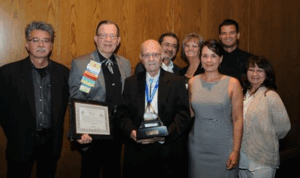
MILESTONE AWARD
Presented by Jon Jones
The CALLERLAB Milestone Award is the highest award CALLERLAB can bestow on any individual. The nominee is judged against rigid criteria in five separate categories. A nominee must meet the criteria in all five categories to receive the award. And they are:
1.Outstanding and significant contribution to the field of square dancing.
- The contributions must have stood the test of time.
- Relates to unselfish contribution, divorced from personal gain and monetary rewards. Requires attitude that thinks of others first.
- Recipient must maintain and conduct self in professional leadership capacity. Professionalism reflecting high standards of leadership to which we have dedicated ourselves in our day-to-day actions.
- Recipient must have exercised broad influence in the square dance activity, although local geographic and highly specialized activity may lead to recognition.
The primary purpose of this award is to recognize individuals who have made outstanding and significant contributions to the field of square dancing. The Milestone award is a recognition by an individual’s peers, which sets the recipient apart from the ordinary. Many consider this to be a Lifetime Achievement Award. I personally consider it to be equivalent to The Square Dance Callers’ Hall of Fame.
I am going to tell you about an individual that many of you do not know. However, by the time I finish, you will know a lot about him.
Our recipient was born and raised on a ranch. He joined the U. S. Air force in the early 1950s and in 1955 he was stationed in Japan. Through a friend, he met a beautiful Japanese lady and married Tamae while stationed there. He was sent back to the U. S. at Rapid City, South Dakota where they learned to square dance. He was transferred back to Japan in 1960 at Yokota Air Force Base with his wife and children.
They continued square dancing with a group on the base, and he began learning to call. The club caller was sent back to the U. S. and Carl became the new club caller. He subscribed to Sets In Order magazine and Les Gotcher’s Caller’s Notes.
Carl and Tame became friends with three young Japanese teenagers (one girl and two boys) who were members of a folk-dance club near Tokyo. They were doing old dances from different countries including traditional dances from the U. S. like Birdie In The Cage, Dip & Dive, Virginia Reel & others using 78 rpm records and translated instructions. After a few visits, the folk-dance club asked Carl to teach them modern square dancing. He agreed to do so, and a class was organized with two squares of young people, most of whom were strangers to each other. Masaru Wada and his girlfriend, Yumiko, were in the first group. They were just out of high school, were sweethearts, and later married.
This was “the introduction” of Modern Western Square Dancing to the country of Japan! 7 This first class went for 12 weeks, and they formed a club named the Lucky Eight Squares. The Lucky 8s visited a club on one of the American bases but were not well received, so the Lucky 8s restricted membership to only Japanese and they danced on Sunday with an open dance every first Sunday. Two classes were taught each year and word got around to folk dance instructors who came to the classes and then they began teaching MWSD to their groups.
Masaru began learning to call during this time frame. Carl also taught callers Tac Ozaki and Naru Okumura to square dance when they were teenagers. Carl is credited by the Japanese with introducing MWSD to their country. Carl’s wife, Tamae, was his interpreter, as she could speak both languages.
As stated above, it is obvious that Carl’s contributions have stood the test of time, as MWSD is very big in Japan and Masaru, Tac and Naru are still involved.
Carl was a strong member of the Far East Square Dance Callers Association and later served as their Chairman. He was very instrumental in helping improve the relationship between the American and Japanese dancers. He got the Americans to move a Labor Day Weekend from Mt. Fugi to an Island in Tokyo Bay where both American and Japanese dancers could attend and dance together with more than 300 in attendance.
The growth of square dancers over the years in Japan has increased from 16 to 15,000, clubs from one club to 550, and from zero callers to 900.
Carl helped lay the foundation for the Japan Square Dance Association and the Tokyo Callers Assoc.
He has stated that all of the lessons he taught in Japan were very interesting because he and Tamae had to teach American customs along with square dance etiquette. He credits most of his success in square dancing in Japan to his wife. Being a native of Japan, she was the teacher of the social aspects and skills needed to square dance and communicate with Americans.
He also taught in other cities like Osaka, Toyohashi, and others. He taught the spirit of square dancing. And, he held square dance parties to make donations to needy children’s groups.
In the few years we have known Carl, he is constantly talking about how the Japanese dancers and callers helped him and Tamae through their friendship and endless communication. Unfortunately, Tamae passed away in Feb. 2011.
After we knew Carl’s story, he was extended an invitation to attend our CALLERLAB Convention in Raleigh, NC. He accepted and he knew that his Japanese caller friends would also be there. When the EC found out who he was, he was asked to be on the Legends panel with Lee Kopman, Don Beck, and John Marshall. He told his story and it was very well received by the large number in attendance. He was also on the Legends panel this year here in Norfolk, VA.
Although he does not call any more, he is well respected in our local callers association.
He also let the Japanese callers use his sound equipment and taught them how to use it. He also taught them how to organize a square dance club and how to run it with human relations.
While he was stationed in Japan, an advertisement in the SIO magazine let them know that Bob Osgood was going to bring a tour group over with Bob VanAntwerp. He contacted Bob and kept him updated on the square dance activities in and around Tokyo. Carl and his dancers met the tour group at the airport with buses and provided them with escorts while in the area.
I want to thank and give credit to Masaru and Tac for supplying some of the information for this presentation.
Carl recorded a singing call “Have I Told You Lately” on the Japanese RCA Victor label.
With the SIO group coming to Japan, Carl organized the Japan and U.S. Friendship Party for the first time. The Japanese dancers said it was an “astonishing sight.”
When he was Chairman of the Far East Callers Association, he started the Japan and U.S. Friendship Convention which was taken over by the All-Japan Square Dance Convention, and they will celebrate their 55th anniversary this year.
When the U.S. National was in San Antonio, TX in 1974, Carl and Tamae were there. They knew the Japanese dancers and callers had chartered an airplane to attend, so they went to the airport to welcome them to Texas. A large delegation of American dancers and National Executive Committee were also there with a red-carpet type welcome. Carl and Tamae did not want to interfere, so they backed way off and were waiting for the proper opportunity to greet the arrivals. Well, some of the Japanese delegation that included Masaru and Yumiko saw Carl and Tamae, shouted their names, and ALL of the Japanese left the American welcome, and ran and surrounded them in jubilation to see their teacher and friends. News media, with cameras and microphones ran to them as well to find out who these people were. THAT, MY FRIENDS, IS BROAD INFLUENCE!
Please join me in presenting the CALLERLAB Milestone Award to Carl Sims from Texas.