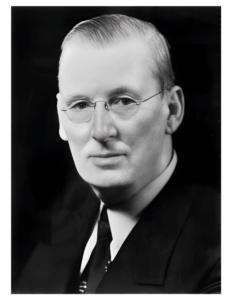
Henry Ford and Benjamin Lovett
by Dave Taylor
SQUARE DANCING magazine, June 1980
This is a story many of you have never heard. We hope that after you have read this you will always remember this caller and point with pride to the historical landmark that bears his name.
To start, we need to go back to the year 1923 when Henry Ford visited the Wayside Inn in Sudbury, Massachusetts. This famous resort offered people who vacationed here dance instruction in the gavotte, the schottische, mazurkas, minuets, the Virginia Reel and square dancing. The teaching was under the leadership of Benjamin B. Lovett.
Mr. Henry Ford enjoyed this program so much that he asked Benjamin Lovett to teach dancing and train dance instructors in Dearborn, Michigan. He offered Lovett a handsome salary and a two-month contract. Benjamin Lovett reluctantly turned down the offer, explaining that he was under contract to the Wayside Inn. It should be noted here that at that time Henry Ford’s personal wealth, exclusive of his automobile business and all other holdings, was in excess of twenty billion dollars. Therefore, Benjamin Lovett’s obligations to the Wayside Inn posed no major problem to Mr. Ford. He simply purchased the Wayside Inn, met the terms of Benjamin Lovett’s contract and renegotiated a new contract to bring him to Dearborn for two months.
Benjamin Lovett stayed in Dearborn, Michigan, for twenty-six years. At a time when the country was in the midst of a depression, Lovett was paid $12,000 per year plus a new Lincoln every year, plus a home, most of his meals, and all of his travel expenses. He had substantial pay raises as the square dance program increased. Once Benjamin Lovett was in Michigan, he and Mr. Ford began to publicize and promote early American square dancing. Two hundred dancing instructors from Ohio and Michigan were invited to Dearborn to learn how to dance and to call the Virginia Reel. Mr. Ford also directed Benjamin Lovett to begin a program for the Dearborn public school children.
Dances that Benjamin Lovett taught and called began to appear in newspapers around the country and included detailed instructions on how to execute these maneuvers. Mr. Ford also sponsored a radio program. Lovett would travel to Chicago every Sunday and call dances on the radio which had been printed in the newspapers during the previous week. This one-hour program was broadcast from Chicago to the East Coast and after an hour wait to compensate for the time differential, the same broadcast was sent to the West Coast.
Old-fashioned square dancing became the rage. At a convention of the Dance Masters of America held at the Waldorf-Astoria Hotel in New York City, the chairman of the convention announced, “Ballroom dancing has problems. The Black Bottom is out; the Charleston is gone; attendance is dropping at dance halls.” “Meanwhile,” he complained, “through the efforts of Benjamin Lovett and the financial backing of Henry Ford, square dancing is on the increase and is more popular than it has ever been.”
Benjamin Lovett became so busy that he had to train additional dance instructors. He developed a minimum staff of twelve to fourteen dance instructors to help him with his ever-increasing workload. The program kept expanding due to the generosity of Mr. Henry Ford. Any school district that wanted a dance program merely had to contact Benjamin Lovett and Mr. Ford would write a check from his personal account and Lovett or one of his instructors would be sent to that school.
Mr. Dick Moore began taking square dancing lessons from Benjamin Lovett at the age of seven and eventually he became Lovett’s assistant. Mr. Moore is a musician and is one of the few men in the history of square dancing who can teach, call, and play for the dance movement. Dick Moore provided most of the history of the Benjamin Lovett story. As he talked to me he smiled broadly and said, “You must know, those were glorious days for him.”
Mr. Lovett, assisted by Mr. Moore, and again sponsored by Henry Ford, was responsible for bringing square dancing and ballroom dancing to thirty four institutions of higher learning, among them Radcliffe College, Stevens College, Temple University, University of Michigan, University of North Carolina and the University of Georgia. Again, there was no charge to these universities. If Lovett approved, Mr. Ford would write a check.
The expansion of square dancing in the Dearborn area created a problem. Square dancing requires more room than ballroom dancing, and soon the halls were not large enough to handle the increased number of dancers so Mr. Ford decided to build a hall. This hall is located in Greenfield Village, site of the Henry Ford museum. It was beautifully decorated with chandeliers and had a hardwood floor that would hold approximately forty squares of dancers. A man was hired six days a week to polish the floor, whether it had been used or not. The building was named Lovett Hall.
As square dancing kept increasing, Mr. Lovett suggested that perhaps records would be another way of promoting the activity. Mr. Ford immediately contacted his good friend, Thomas Edison, and soon 78 rpm square dance records appeared on the Edison label. They were unlike the 78 records you might be familiar with for they were at least a quarter of an inch thick. Later records were put out on another label and they corresponded with the more familiar size of 78-rpm records.
Mr. Ford purchased several Stradivarius instruments dating from 1739 and 1754, as well as an Irish dulcimer. These instruments were used for these recordings as well as for some others for Mr. Ford’s private listening enjoyment. These extremely valuable instruments are now on display in Greenfield Village at the Henry Ford museum.
In 1926 Henry Ford published an excellent book on early American square dancing – entitled “Good Morning.” Mr. Ford then sent Benjamin Lovett to the Engleside Club and to the Yacht Club with the net result that these two square dance clubs lasted some twenty-five years. Back in the mid-fifties, I had the pleasure of calling for each one of these groups. Mr. Ford had his own square dance club every Friday night at Benjamin Lovett Hall taught by Benjamin Lovett and assisted by Dick Moore.
In the archives of the Henry Ford Museum, several written accounts of former executives report that Mr. Ford invited all of his executives to take lessons in early American square dancing. He was quick to tell them that he wanted them to take these lessons of their own free will, and not under any pressure. In my interview with Dick Moore, Mr. Moore assured me that an invitation from Mr. Ford, however, was tantamount to a command from royalty. Therefore Benjamin Lovett never lacked for a large crowd.
A typical evening of square dancing at Lovett Hall would find the Ford Orchestra playing gavottes, schottisches, mazurkas, minuets, as well as square and round dancing. The square dances and round dances included such all-time favorites as the Canadian Barn Dance, Red River Valley, Captain Jinks, Oh Susanna, Billy Boy, Gunnings Quadrille and Nelly Bly. Among the rounds were the Heel and Toe Polka and the Blue Danube Waltz.
The dance would end only when Mr. Ford made that decision, at which time he would inform Benjamin Lovett. Benjamin Lovett would then take the stage, get everyone’s attention and say, “Mr. and Mrs. Henry Ford bid you good evening.” Everyone sang America The Beautiful and danced a final waltz.
Benjamin Lovett was a strong leader in early American square dancing. He was the personification of a gentleman. Regardless of the fact that most of his dancers were people of great wealth and position, he told them what they were to wear and what they were not to wear. He insisted that the ladies wear formal dresses and corsages. Men were told that they were to wear dark suits. The ladies were instructed that they were never to cross their legs at the knees, but only at the ankles. No one was allowed to walk across the ballroom floor. If one wished to get to the other side, he was instructed to walk around the perimeter.
The only person who violated this rule was Henry, himself, who might occasionally stroll straight across the hall and smile at Benjamin just to let him know who was really the boss. Benjamin would neither smile back nor comment, but the redness of his face showed his displeasure.
In the early 1940’s square dancing was still doing rather well at Benjamin Lovett Hall even though Mr. Ford was getting up in years. However, upon his death and the loss of his financial backing, Benjamin Lovett could no longer sustain the great promotion of the activity.
In 1949 an early American square dance was held at the Dearborn Country Club to honor Lovett. Clara Ford, Henry’s widow, made one of her rare public appearances and sat in the balcony as a spectator. Mr. Dick Moore was asked to call the dance. He invited Benjamin Lovett to call one set of dances. Upon taking the microphone, Mr. Lovett announced his retirement, effective immediately, and informed the people that his car was outside and his suitcases were packed. He and his wife were going back to Massachusetts. He was never seen again in the Michigan area, and in 1951 Benjamin Lovett passed away.