
24th CALLERLAB Convention 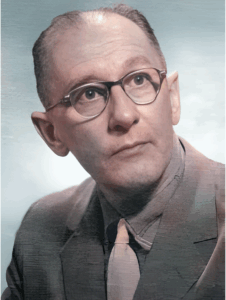
MILESTONE AWARD
Presented by Al Brundage
This evening it is my great honor and pleasure to introduce a leader with a unique background who has contributed a great portion of his life to pave the way for the calling activity we enjoy and take for granted today.
It is not an everyday occurrence to find someone who has been a part of the square dance activity for more than 75 years. A man who was born in 1905 and started square dancing in 1917 at the age of 12.
Our nominee was dedicated to being a leader and his field was physical education. He recognized that dancing fit ideally as part of the physical education program and saw to it that this American activity became part of his program as well as his recreation. Following his graduation from Springfield College in Massachusetts, he inaugurated his program at his first teaching position as instructor of physical education at Kansas State College – now Kansas State University.
After joining the staff at the University of Minnesota he worked his way up to professor of physical education and in 1938 started calling so that he could introduce square dancing into the curriculum of the Minnesota schools and his recreational sessions had as many as 450 ·students on the floor.
In 1947, our nominee was co-founder of the Folk Dance Federation of Minnesota which was soon changed to the Minnesota Square Dance federation.
From 1948 to 1951, he conducted workshops and short courses in square dancing and called for festivals from Canada to Florida, from New York to California for square dance organizations and for more than 35 colleges and universities.
From 1949 with Charlie Thomas (originator of American Square Dance Magazine) and Jimmy Clossin (CALLERLAB Milestone recipient), he started the American Squares Summer Camp in Medford, New Jersey and became director of this camp when it was moved to Laretto, Minnesota.
He is co-founder of the International Square Dance Festival in Chicago that sponsored annual festivals from 1950 to 1957. He assisted in the formation of ‘Swingmasters’, the Minnesota Callers Association – served as officer and taught caller clinics. I quote him when he said, “I think my biggest contribution to the activity was the training of teachers and callers at the University of Minnesota and the American Square Dance Camp over a period of 25 years.’
He called and taught at many National Square Dance Conventions, National Recreation Conventions, and Dance Masters National Conventions in addition to many state and local conventions and conferences.
He attended innumerable institutes, participating in some and serving on staff at others. At the 1947 Festival of Nations in St. Paul, Minnesota, when contemporary square dancing was just an infant, Ralph presented a demonstration consisting of 48 squares from statewide clubs causing tremendous interest in the square dance activity.
From 1947 to 1952, he was chairman of the Folk Dance Committee of the Folk Arts Association of America and while conducting an evening of square dancing as a feature attraction at the National Physical Education Convention in Detroit, he electrified the crowd by having the Governor ‘Soapy’ Williams call a tip.
Not only has our nominee made outstanding and significant contributions to the square dance activity throughout his career, but he has also distinguished himself in his basic field. He coached gymnastic teams at Minnesota, winning six Big Ten championships and his individual team members won 35 Big Ten championships and 6 national titles.
He served on the United States Olympic Gymnastic Committee for the games of 1948, 1952, and 1956. During World War Two, he had the distinction of being Chief of the Army Rehabilitation Program at all Army hospitals. It was while serving in this capacity during off hours, that he had the opportunity to visit and call for early square dance groups across the country.
He is the co-author of two books on square and round dancing and associate editor of two national square dance publications, material on the Viennese Waltz written by our nominee in the early 1940’s, was included by permission in Lloyd Shaw’s, ‘The Round Dance Books” in 1948.
When there were relatively few usable records available for square dancing, he served on a committee to prepare a booklet on recordings for dance. He was responsible for the sections on folk, square, round, and ballroom. The work was published in 1950.
Over the years he has supported what he has taught with written material that has proven to be invaluable to the students of square dancing. He published more than 20 articles in square dance magazines and in 1950 was co-author of the book, “Developing the Creative Square Dance Caller.’
Our nominee was active in dance in one form or another throughout the United States and between 1956 and 1969 he traveled to more than 80 countries around the world, calling and teaching in some and observing the folk dances of the people wherever possible.
Between 1956 and 1968, he was a Fulbright Lecturer at the University of Rangoon, Burma; National Teachers College, Teheran, Iran; and the University of Baghdad, Iraq.
In 1969 he represented the National Association in the Dance division at the annual International Council for Health, Physical Education and Recreation in Abidjan, Ivory Coast, Africa, where he conducted sessions for delegates from all over the world.
Our nominee has been widely recognized for his work over the years. In 1959 he was elected to the Helms Foundation National Hall of Fame, and in 1962 was named “Coach of the Year” by the National Association of College Gymnastics Coaches. He was listed in “Who’s Who in American Education”, ‘Who’s Who in the Midwest”, and ‘Who’s Who in International Gymnastics”.
Before introducing this distinguished gentleman, I must tell you of my personal involvement in being associated with him in a round-about way of which most of you today are not aware.
When the square dance activity was an infant, there were no magazines, note services, recordings, or other methods of gathering information on square or round dancing. Pappy Shaw dreamed up the idea that if the activity was to survive, we needed a method of communication so that ideas and dance material could be shared by the leaders around the country. I was privileged to be one of the 12 leaders to be included in the “Round Robin.” This consisted of one or two pages of ideas, gimmicks, new material, or just chit-chat about what was happening locally from each caller on the list. ‘Pappy” started it off, sent it to Ed Gilmore, and the idea was that the packet went around the complete loop about twice a year. When you received it you had two weeks to digest it, make notes from it, add your contribution, and then mail it to the next person on the list. I received my packet from Bascom Lamar Lunceford who represented the Appalachian area and was full of ideas and material on our Southern Mountain Dancing. After adding my contribution, representing the New England area, I would send the “Round Robin” along to Floyd Woodhull in Elmira, New York (his Blackberry Quadrille on RCA Victor was one of the best and earliest instrumental pieces of the day – and I’m sure there are some old-timers here that still carry it in their record case).
Floyd would send it along to Ralph Piper and I recall with much humbleness and respect the orderly and highly informational contributions of the person you are about to meet.
It is with many fond memories of the past, and with my deepest respect and enthusiasm, that I nominate to receive CALLERLAB’s highest award – the Milestone – DR. RALPH PIPER!