
44th CALLERLAB Convention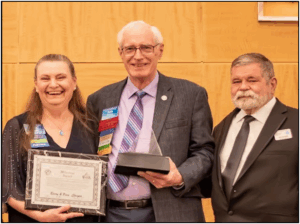
Milestone Award
Presented by Clark Baker
Tonight’s Milestone is unusual as it is one of the rare instances in which it will be awarded to a couple. Let’s think of him as “The Entertainer” and the two of them as
“The Easy Winners”. They were born in the same hospital, one in 1960 and the other in 1962. At the age of 14 his mother and sister dragged one of our recipients to
a square dance class. They told him he didn’t have to keep doing it, but he did have to try, He stuck with the lessons until he broke his arm. He returned to the class
next year, which is when our other recipient enters the scene. This would be 1975. They became partners for several years and then an “item” in 1978. They continued
to dance with the teen club until it dissolved.
Jumping ahead, our recipients were married in Japan in 1988 by the Japanese square dancers with kimonos and everything. Their actual marriage 5 was back in the States in 1989. They have never lived far from where they grew up and have several hobbies outside our dance activity. Fortunate to live in a climate where things grow, their whole backyard is devoted to 40 chickens, several ducks, and growing 15 different fruits, 15 different vegetables, and many herbs. They have recently become beekeepers, and their 2016 harvests brought in over 100 pounds of honey.
Our recipients enjoy round dancing and contra dancing, but they especially enjoy swing dancing. This would be the East Coast or jitterbug style. They once entered a
local swing dance competition where “Doc” Severinson was the judge. While they came in second, “Doc” later told them that their style of swing dancing was more
authentic than the more impressive aerials that the winning couple did.
Our recipients have mathematical, logical minds and by high school they were learning Advanced dancing. A year later they were learning Challenge dancing. At that time he developed an interest in calling and started by walking their tape group through some sequences he had written. Later he called written sequences to taped music, then purchased a Hilton and a microphone, and really started learning how to call.
He started calling Challenge square dancing in 1981 and several years later I received a cassette tape from his dancers. They said they thought their caller was real good and we should see what we think. The tape was labeled “Vic Ceder C4-001 Winter ’84”. As I remember, our group thought his choreography was good, interesting, creative, clever, and we looked forward to more tapes from him.
CALLERLAB’s Milestone Award is our highest award. Our recipients tonight, Vic and Debbie Ceder, have unselfishly worked in an uncharted area of square dancing, their work has had broad influence on our activity, and it has stood the test of time. I have more to say about their contributions, but first a brief history lesson.
Modern Western Square Dancing came into its own in the 1950s. At that time, computers cost a million dollars and filled a room. Over time computers got cheaper
and were connected together on networks. By 1980 the personal computer arrived. CALLERLAB, in 1983 and for several years afterwards, offered an interest session
on computers explaining why you might want one and what you could do with your own computer in your square dance business. In the 1990s, with the advent of
the World Wide Web, dancers, callers, and clubs started creating their own websites. For example, Dosado.com was started in 1995, and CALLERLAB.org was
started in 1999.
Vic has a degree in mathematics and is a computer programmer. In the 1990s he was interested in learning more about databases and building websites, especially websites whose pages are dynamic. That is, the pages are created by running a computer program and not simply static text. By 1999 he had created ceder.net and it was open for business. The initial website had pages for tape sales, special events schedule, the beginning of a caller/cuer database, a choreography database for short sequences and get-outs, and lists of calls, definitions, and frequency counts.
You are probably familiar with this phrase, “if your only tool is a hammer, everything looks like a nail.” This idea was first reported by Abraham Kaplan in 1964 who said, “I call it the law of the instrument, and it may be formulated as follows: Give a small boy a hammer, and he will find that everything he encounters needs pounding.” Well, Vic is our small boy, a database is his hammer, and to square dancing’s benefit, everything he encounters needs to be in a database with Debbie’s help.
Many dancers, callers, and clubs created websites and a universal truth emerged –it is much easier to create your website than it is to maintain it, especially over years and decades. Many websites have fallen into disrepair. However, Vic and Debbie have kept ceder.net working, up-to-date, organized, reorganized, and they were always adding new content. For example, when Debi Bliss wanted to give up her wonderful website with a large collection of square dance articles and information, the Ceders got permission to incorporate that into their website, assuring that Debi’s work would continue to remain accessible and searchable. I expect this “saving information from defunct websites” has happened several times. When others have great websites with useful content, ceder.net links to them. As the World Wide Web grew, the Ceders simply did their own thing, using their own esthetics, and did their part in helping square dancing grow.
Unlike most square dance websites, ceder.net is still around and better than ever. I expect most of you have used it, perhaps recently. Here are some statistics to give you a sense of what they have accomplished and maintain:
• Square Dance Article Co-op — 420 articles
• Caller and Cuer Database — 1992 callers and cuers from 22 countries
• Club Database — 1193 square and round dance clubs from 26 countries Choreography Database — 8,845 sequences
• Events Database — 61 events listed in 2017 (197 in 2012)
• FAQ Database — ~600 Frequently Asked Questions and Answers, including choreography questions and opinions
• Square Dance Resources — by Country, State or Province Square Dance Links – organized and curated
• Square Dance Calls — 500 calls with their own definitions, examples, and commentary
o While for sale in book form, individual call definitions are available online for free
o Translated into five other languages
o Respected and used around the world
o CALLERLAB used their C3A definitions as our starting point
• Record Database — square dance music, cue sheets, and lyrics
I listed the record database last because I wanted to say a few words about it. Vic and Debbie have been collecting square dance records. I expect their goal is to have one copy of each square dance record ever produced. While the records sit on shelves in their house, each is entered in the database.
• 16,945 records, representing 376 record labels
• 13,972 sound clips – Yes, they have digitized that many records. (The website presents the first 30 seconds of sound.)
• 12,479 cue sheets – Yes, they have typed in that many cue sheets.
• 3,702 lyrics
Think of what an outstanding piece of square dance history they have captured. While they can’t sell or give away the digitized records, these sound recordings are preserved and catalogued. Vic and Debbie are their own square dance record museum.
Two other important aspects to the website:
1) Ceder.net allows users (callers and clubs) to create and maintain their own entries. This reduces the workload on Debbie.
2) When appropriate, database entries from one database contain links to other databases. For example, the entry for a square dance caller shows the clubs they call for, the events they are calling at, the records they have recorded on, and the articles they have written.
In addition to ceder.net, Vic has created two other pieces of software, which are widely used and deserve mention. The first is a square rotation program used by some groups to assign dancers into squares throughout a dance or weekend. The square mixing methods we used before programs like his square rotation program were not as easy to use and effective. The other program is his Ceder Square Dance System which he uses to write choreography by having the computer move the checkers, catalogue choreography so he can quickly find the appropriate next sequence he wants to call at a dance, display the sequences while calling, catalogue the digital music on his laptop, and play the music. By integrating all these functions into a single program, Vic is able to have one set of controls and fewer “oops” moments while calling with a laptop. He makes this software available for a fee, and it is popular in the Challenge community.
We learned that Vic started calling in 1981. What I didn’t say is that he is self taught. He is a dancer and a keen observer of callers as they perform. He knows and remembers what he likes and dislikes in choreography, music, delivery, etc. and has worked to produce in his calling a product that he and Debbie would enjoy dancing to. We hope that each caller new to Challenge square dancing brings something to that activity and Vic’s contributions and ideas have been outstanding. He has put calls together in ways we haven’t seen before, but that make sense. He has embraced the field of asymmetric choreography and is the king. He has added new calls and concepts to our vocabulary.
Vic is not only a Challenge caller. He teaches beginners lessons and calls Mainstream and Plus. Here is a Mainstream example of Vic’s choreography, taken from ceder.net’s choreography database available to any of you.
• (Zero Line)
• Pass Thru,
• Wheel & Deal,
• Centers Half Sashay, [as most of you probably realize this is clever because of
body flow and not the usual next call]
• Zoom, [this also has great body flow]
• Centers Square Thru 3,
• Dosado To A Wave,
• Swing Thru,
• Boys Run (Zero Line)
In addition to everything I have said, they are really nice people and good friends. Please join me in awarding CALLERLAB’s Milestone to Vic and Debbie Ceder.